
Category Archives: Data Compliant

HMRC’s 28 days to delete unlawfully obtained biometric data

In a statement released on 3rd May, the Information Commissioner’s Office reiterated their decision to issue HMRC a preliminary enforcement notice in early April. This initial notice was based on an investigation conducted by the ICO after a complaint from Big Brother Watch concerning HMRC’s Voice ID service on a number of the department’s helplines since January 2017.

HMRC did not give customers sufficient information

The voice authentication for customer verification uses a type of biometric data considered special category information under the GDPR, and is therefore subject to stricter conditions. ICO’s investigation found that HMRC did “not give customers sufficient information about how their biometric data would be processed and failed to give them the chance to give or withhold consent.” HMRC was therefore in breach of GDPR.

The preliminary enforcement notice issued by the ICO on April 4th stated that HMRC must delete all data within the Voice ID system for which the department was never given explicit consent to have or use. According to Big Brother Watch, this data amounted to approximately five million records of customers’ voices. These records would have been obtained on HMRC’s helplines, but due to poor data security policy for the Voice ID system, the customers had no means of explicitly consenting to HMRC’s processing of this data.

Steve Wood, Deputy Commissioner at the ICO, stated, “We welcome HMRC’s prompt action to begin deleting personal data that it obtained unlawfully. Our investigation exposed a significant breach of data protection law – HMRC appears to have given little or no consideration to it with regard to its Voice ID service.”

The final enforcement notice is expected 10th May. This will give HMRC a twenty-eight-day timeframe to complete the deletion of this large compilation of biometric data.

The director of Big Brother Watch, Silkie Carlo, was encouraged by the ICO’s actions:

“To our knowledge, this is the biggest ever deletion of biometric IDs from a state-held database. This sets a vital precedent for biometrics collection and the database state, showing that campaigners and the ICO have real teeth and no government department is above the law.”

 Harry Smithson, May 2019. 
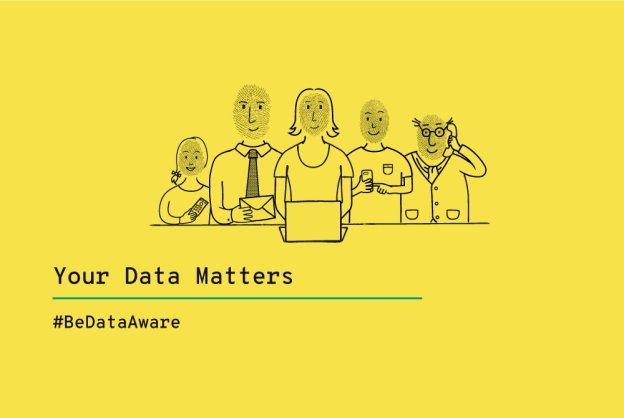
Be Data Aware: the ICO’s campaign to improve data awareness

As the Information Commissioners Office’s ongoing investigation into the political weaponisation of data analytics and harvesting sheds more and more light on the reckless use of ‘algorithms, analysis, data matching and profiling’ involving personal information, consumers are becoming more data conscious. The ICO, as of 8th May, has launched an awareness campaign, featuring a video, legal factsheets reminding citizens of their rights under GDPR, and advice guidelines on internet behaviour. Currently the campaign is floating on Twitter under #BeDataAware.

80% of respondents considered cyber security to be a ‘high priority’ 

While the public is broadly aware of targeted marketing, and fairly accustomed to the process of companies attempting to reach certain demographics, the political manipulation of data is considered, if not a novel threat, then a problem compounded by the new frontier of online data analytics. Ipsos MORI’s UK Cyber Survey conducted on behalf of the DCMS found that 80% of respondents considered cyber security to be a ‘high priority,’ but that many of these people would not be in groups likely to take much action to prevent cybercrime personally. What this could indicate is that while consumers may be concerned about cybercrime being used against themselves, they are also aware of broader social, economic and political dangers that the inappropriate or illegal use of personal information poses.

ICO’s video titled ‘Your Data Matters,’ asks at the beginning, “When you search for a holiday, do you notice online adverts become much more specific?” Proceeding to graphics detailing this relatively well-known phenomenon, the video then draws a parallel with political targeting: “Did you know political campaigners use these same targeting techniques, personalising their campaign messaging to you, trying to influence your vote?” Importantly, the video concludes, “You have the right to know who is targeting you and how your data is used.”

To take a major example of an organisation trying to facilitate this right, Facebook allows users to see why they may have been targeted by an advert with a clickable, dropdown option called ‘Why am I seeing this?’ Typically, the answer will read ‘[Company] is trying to reach [gender] between the ages X – Y in [Country].’ But the question remains as to whether this will be sufficiently detailed in the future. With growing pressure on organisations to pursue best practice when it comes to data security, and with the public’s growing perception of the political ramifications of data security policies, will consumers and concerned parties demand more information on, for instance, which of their online behaviours have caused them to be targeted?

A statement from the Information Commissioner Elizabeth Denham as part of the Be Data Aware campaign has placed the ICO’s data security purview firmly in the context of upholding democratic values.

“Our goal is to effect change and ensure confidence in our democratic system. And that can only happen if people are fully aware of how organisations are using their data, particularly if it happens behind the scenes.

“New technologies and data analytics provide persuasive tools that allow campaigners to connect with voters and target messages directly at them based on their likes, swipes and posts. But this cannot be at the expense of transparency, fairness and compliance with the law.”

Uproar surrounding the data analytics scandal, epitomised by Cambridge Analytica’s data breach beginning in 2014, highlights the public’s increasing impatience with the reckless use of data. The politicisation of cybercrime, and greater knowledge and understanding of data misuse, means that consumers will be far less forgiving of companies that are not seen to be taking information security seriously.

Harry Smithson, 9 May 2019

The GDPR and Profiling

Profiling is a very useful tool which marketers have been using for decades to understand their customers better and to target them appropriately.  However, the GDPR does make some changes to how profiling is considered which should be considered carefully before profiling is undertaken.  For the first time, profiling has been included with automated processing decision-making and the same rights apply to the individuals whose information is being profiled. So how does this affect businesses?

Profiling Benefits

There are obvious benefits both to businesses and consumers in relation to profiling, which is used in a broad number of sectors from healthcare to insurance, retail to publishing, leisure to recruitment.

It is also an extremely useful tool for marketers, providing benefits of increased efficiency, savings in resource, and the financial and reputational benefits of understanding customers and establishing more personal, relevant communications with them.  The customer or individual benefits in turn from receiving fewer communications, and far more relevant messages.

What is profiling?

The GDPR defines profiling as: “any form of automated processing of personal data consisting of the use of personal data to evaluate certain personal aspects relating to a natural person, in particular to analyse or predict aspects concerning that natural person’s performance at work, economic situation, health, personal preferences, interests, reliability, behaviour, location or movements”

Profiling can be as simple as segmenting your own customers into groups based on gender, purchase history, and other data that the customer has provided to you during your relationship.  It becomes more complex when additional data is added to the mix, for example, adding to the information your customer has provided you, by applying data from external sources such as social media, or providers of geo-demographic or lifestyle data.

Profiling and the GDPR

As with all processing under the GDPR, those who profile individuals have responsibilities to those individuals.  Profiles must be accurate, relevant, and non-discriminatory.  All 6 GDPR Principles become critical as profiles are evolutionary, and over time, individuals’ profiles will change. So accuracy and retention are critical.  Privacy by design is key.  As is the requirement that individuals must be made aware of such profiling and of their right not to be subject to such decisions.

It’s worth noting that automated decisions can be made with or without profiling.  And the reverse is also true – profiling can take place without making automated decisions.  It’s all a matter of how the data is used.  Where manual decisions are made, Article 22 does not apply.

Consent or Legitimate Interests?

The legal basis under which profiling takes place is a matter for careful consideration.  There has been debate over whether profiling requires the consent of the individual who is being profiled, or whether legitimate interest may apply.

There will be instances where the impact of the profiling will have a legal or significant effect – for example, in financial services (mortgage yes or no), or when marketing to vulnerable customers – for example, gambling products to those in financial difficulty.  Where profiling is considered to have a legal or significant effect, an organisation will need to rely on the legal basis of Consent before profiling and making decisions on the basis of such profiling.

However, in many cases, marketing will not have such an impact, and in those cases, consent will not be required.  Instead it may be possible to rely on Legitimate Interests.  BUT before such a decision is made, a Legitimate Interest Assessment will need to be conducted.  This will need to consider the necessity of the profiling, the balance of benefits to the individuals versus the business, and the measures taken to protect the personal data and profiles involved.

The Legitimate Interest Assessment will not only help you determine whether it is appropriate to conduct the profiling on this basis, it will also provide evidence that the individuals’ rights have been considered, contributing to the business’s need to meet the GDPR’s new principle of Accountability.

Victoria Tuffill  7th March 2018

New US Privacy Bill on the Way

Core US Privacy Principles

 On 18th November Democratic Senators issued a set of core principles that should underpin any proposed Federal Privacy legislation.

The principles cover several issues across four categories to protect consumer privacy: (1) establish data safeguards, (2) invigorate competition, (3) strengthen consumer and civil rights, and (4) impose real accountability.

New US Privacy Bill

Then on November 26, 2019, the senators unveiled a new comprehensive federal privacy bill entitled the Consumer Online Privacy Rights Act (“COPRA”).

The bill would create a new bureau within the Federal Trade Commission. The bureau would promote data security and strengthen the law at State level.

COPPRA would amongst other measures: 

  • grant citizens new privacy rights, including the rights to access, delete and correct their data, as well as a right to data portability;
  • require organisations to obtain express, affirmative consent for the collection and use of sensitive data
  • prohibit the use of certain types of personal data including race, ethnicity and gender from being used to discriminate in decisions on   employment, credit, housing or education.
  • require organisations using algorithms to take decisions to undertake an algorithmic decision-making impact assessment.

Interestingly COPPRA seeks to exclude small businesses with annual revenue of less than $25 million from its requirements, as long as they process the data of fewer than 100,000 individuals or households annually.

If enacted the legislation is likely to impact businesses handling data of US citizens.  It should ease the transfer and processing of personal data for companies operating in different US States.

If you have any questions about data protection, please contact us via email team@datacompliant.co.uk or call 01787 277742. You can find more of our blogs here.

Gareth Evans, 2nd December 2019