I was invited by ComputerScienceZone to share this fascinating infographic on my site – so here it is – a fascinating insight into the diversity and number of “things”, combined with the risks associated with the rapid growth and poor security.


I was invited by ComputerScienceZone to share this fascinating infographic on my site – so here it is – a fascinating insight into the diversity and number of “things”, combined with the risks associated with the rapid growth and poor security.
 When we talk about data security what do we actually mean?
 Data security means protecting data, such as database, from destructive forces and from the unwanted actions of unauthorised users.
In the UK, the Data Protection Act is used to ensure that personal data is accessible to those whom it concerns, and provides redress to individuals if there are inaccuracies. This is particularly important to ensure individuals are treated fairly, for example for credit checking purposes. The Data Protection Act states that only individuals and companies with legitimate and lawful reasons can process personal information and cannot be shared.
The international standard ISO 27001 covers data and information security. Information security is the practice of defending information from unauthorised access, use, disclosure, disruption, modification, perusal, inspection, recording or destruction. It is a general term that can be used regardless of the form the data may take (e.g. electronic, physical)
Data Security is subject to several types of audit standards and verification, the most common are ISO 27001, PCI, ITIL. Security Administrators are responsible for creating and enforcing a policy that conforms to the standards that apply to their business.
IT certification audits are generally carried out by 3rd parties although regular internal audits are recommended. Clients can also carry out audits before they begin doing business with a company to ensure that their clients data is secured to their standards.
A security policy is a comprehensive document that defines a company’s methods for prevention, detection, reaction, classification, accountability of data security practices and enforcement methods. It generally follows industry best practices as defined by ISO 27001, PCI, ITIL or a mix of them. The security policy is the key document in effective security practices. Once it has been defined it must be implemented and modified and include any exceptions that may need to be in place for business continuity. Most importantly all users need to be trained on these best practices with continuing education at regular intervals.
Data needs to be classified in the security policy according to its sensitivity. Once this has taken place, the most sensitive data has extra measures in place to safeguard and ensure its integrity and availability.
All access to this sensitive data must be logged. Secure data is usually isolated from other stored data and it is important that controlling physical access to the data centre or area where the data is stored is implemented.
Active Directory for example is used by many companies and is a centralised authentication management system that is used to control and log access to any data on the system.
Encryption of the sensitive data is critical before transmission across public networks. The use of firewalls on all publicly facing WAN connections needs to be in place and also the deployment of VLANs’ to isolate sensitive departments from the rest of the network. It is important to shut down unused switch ports. If Wi-Fi is deployed then it is important to use authentication servers to verify and log the identity of those logging on. Finally the deployment of anti-virus and malicious software protection on all systems.
Sometimes you will be surprised what you can find by simply walking around and look for passwords in the open, unattended screens.
Ensure that Event Viewer and Log Files are maintained this provides the audit trail. An Intrusion Detection/ Protection systems (IDS/IPS) to monitor the network and system activities for malicious activities or policy violations. Set up SNMP monitoring servers to monitor and alert for everything as this will alert Administrators to everything from unusual bandwidth usage to hardware failure. It is key to know what’s going on with your systems and network.
Documentation is also important, detailed network maps should be available as these maps make it easier to spot security weak points and any flaws in the design that could impact the data security.
You should also consider a network scanner that probes devices to ensure that they are secure. A network scanner will probe and report old out of date software, open ports and the give details on any potential exposures. Networks scans should be scheduled on a regular basis.
Review log files regularly of any publicly facing server to see what types of attacks are being run against your enterprise.
Trade publications discuss the latest threats and technologies keeps you updated on the latest attack trends. It is important to understand the technology stack that you are protecting and the technology that is used to attack it.
Something which tends to not be given the required level of importance is user education. All relevant security policies must be clearly explained to the end users. A clear explanation of the consequences for violating these polices must also be explained. The end user needs to sign a document acknowledging that they understand the policies and consequences for violating these policies.
Any enforcement must obtain executive authority to enforce the business policies and procedures. This must be based on a systematic approach of warnings and punishments.

The author, Tony Schiffman, is Data Security Director at Data Compliant. If you have any concerns about your organisation’s data security or vulnerabilities and you’d like a chat, please call Tony on 01787 277742 or email dc@datacompliant.co.uk


Many data breaches are a direct result of the attacker using individuals or employees to access systems or data, and it’s worth noting that 58% of large organisations and a third of SMEs fall prey to staff-related data breaches (*UK 2014 Information Security Breaches Survey).
With that in mind, I thought it would be helpful to summarise some points to help recognise and deal with phishing emails.
Phishing is a deceptive means of trying to acquire personal information such as your identity or data that you hold and access – for example your user name, passwords, credit card details, contact directories and so on. Phishing is typically carried out by email or instant message, which may ask you to provide the data directly, or it may send you to a website or phone number where you will be asked to provide data.
A phishing effort can be hard to recognise, particularly if it comes from a source that you are inclined to trust – for example a friend or colleague (who may have been phished themselves), or your bank, social media site, telephone provider etc.
There are ways to recognise and avoid being caught out by fraudulent emails or the links they contain.
Such links are likely to include all or part of the legitimate website address.
Being aware and understanding how to spot a potential phishing effort is helpful, but additional steps should be taken to protect your computer and system against such attacks. There is no single solution – the best option is to adopt a multi-layered approach:
Just opening the email is unlikely to cause a problem. However, it is helpful to report phishing emails:
If you have any concerns about your organisation’s vulnerability to phishing attacks and you’d like a chat about staff training or prevention, just call 01787 277742 or email dc@datacompliant.co.uk
It’s becoming an increasingly essential part of due diligence that a data controller, when appointing a data processor, will ask one simple question: “Do you have ISO 27001 Certification?” Given that data controllers are the liable parties for any data breaches or lack of compliance, they need to be certain their data is to be processed safely. So if the answer is “no”, the processor is unlikely to win the contract unless they have some other extraordinary and unique competitive advantage.
I was going to write a blog about why ISO 27001 certification is so important. Then I thought it would be simpler just to show you. It’s all about protecting your business from potential breaches.
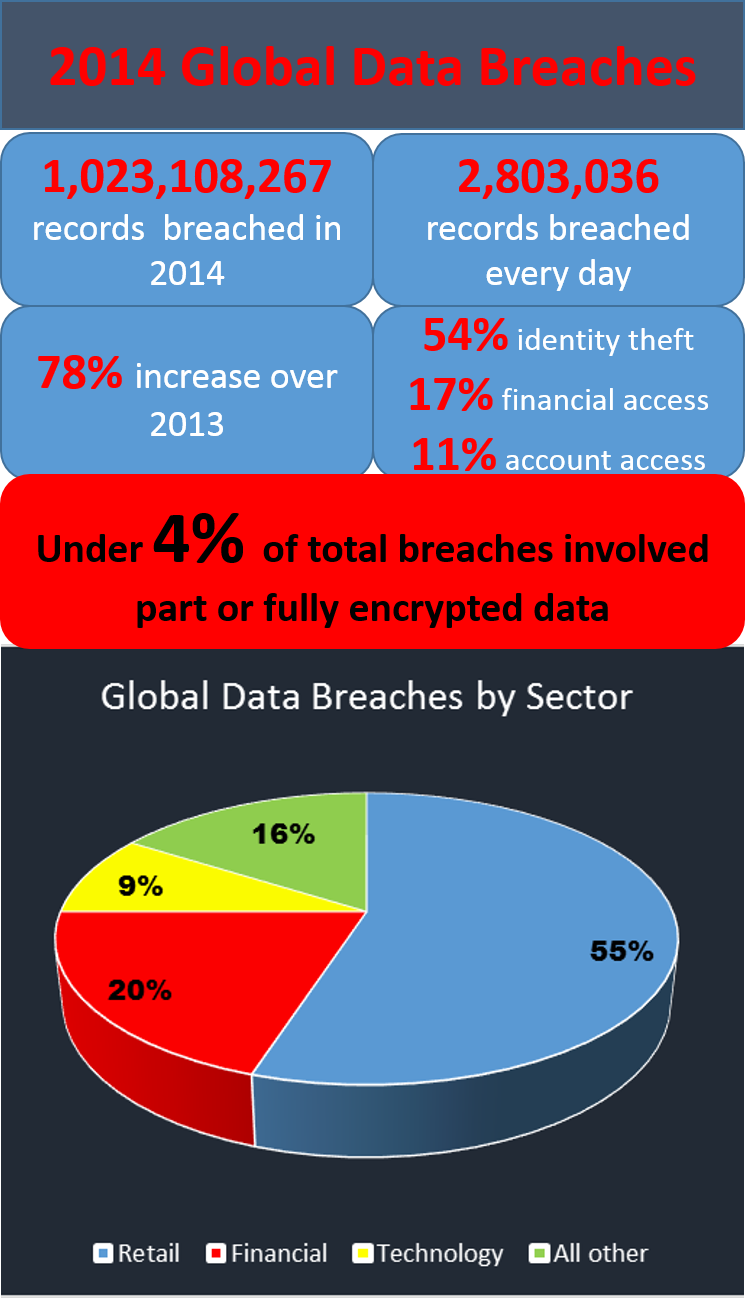 From the stats above, taken from the 2014 Year of Mega Breaches and Identity Theft, it’s clear to see:
ISO 27001 is an international standard for data security management, providing a risk-based approach to data security that involves a data governance standard that is embedded throughout the business covering processes, technology, employees and training.
In the past, obtaining ISO 27001 certification has been a time-consuming, arduous and costly exercise. Now, however, the whole process of creating the gap analysis, providing robust policies and procedures, and obtaining certification can be made much simpler.
If you’d like to know more about getting ISO 27001 quickly, simply and cost-effectively, please get in touch on 01787 277742 or email victoria@datacompliant.co.uk – we’ll be happy to have a chat and answer your questions
Retail and financial services websites are at the highest risk from attack, and Christmas – with a projected online spend of £17.4bn** – is the most popular time of year for cyber criminals.
A Google study from a couple of weeks ago made an astonishing statement:

This is a particularly worrying statistic given that data security breaches carry a huge cost – both to reputation and financially.

The costs of a breach increase every year, and will inevitably continue to rise as new legislation comes in with greater powers to the ICO.
So it’s time for retailers to make sure their staff don’t fall into the 45% of successful phishing attacks, and understand how to minimise security risks to the business.

Data Compliant provides data security training workshops for companies who want their employees to understand how to keep their data secure.
2-hour security workshops for up to 10 attendees per session are available from January 5th 2015. The usual cost is £1,100*. Within the workshop, we’ll demonstrate how to recognise and avoid phishing attacks.
* Stats taken from UK 2014 Information Security Breaches Survey – Department for Business Innovation and Skills
**stats from internetretailing.net
* Costs exclude VAT and expenses.
 Clearly surveillance has both benefits and drawbacks, and the level of public interest and debate about both is increasing. Technology is advancing swiftly, and surveillance cameras are no longer simply passively recording and retaining images. They are now also used proactively to identify people of interest, to keep detailed records of people’s activities both for social (eg schooling, benefits eligibility) and political (eg terrorist) reasons.
There’s a real risk that, despite the benefits, use of CCTV can be very intrusive.
The ICO’s new CCTV code of practice continues its focus on the principles that underpinned the previous code of practice. However, it has been updated to take into account both the changes in the regulatory environment and the opportunities to collect personal data through new technology.
There is some fascinating information in the guidelines – specifically around some of that new technology, where three of the key recommendations are:
The new technology specifically covered in the guide includes:
Automatic Number Plate Recognition (when to use it, data storage, security issues, sharing the data and informing individuals that their personal data is being processed – something of a challenge needing some creative thinking);
Body Worn Video (warnings against continuous recording without justification; the use of BWV in private dwellings, schools, care homes and the like – and, again, the thorny issue of informing subjects that they are being recorded);
Unmanned Aerial Systems drones are now increasingly used by businesses as well as the military (Amazon has stated its intention to use drones to deliver parcels …). Some of the key issues are privacy intrusions where individuals are unnecessarily recorded when the drone has some other purpose; the distinction between domestic and commercial use; providing justification for their use; the ability to switch the recording system on and off; the whole system of data collection, storage, accessibility, retention periods and disposal requires compliance.
Automated recognition technologies are increasingly used commercially to identify individuals’ faces, the way they walk, how they look at advertising and suchlike. Again, the issues of fair processing, degree of accuracy of images and their identification, storage, retention, transfer, disposal and security are all key to compliance.
If you are using surveillance devices to view or record and / or hold information about individuals, then it’s worth noting that such use is subject not only to the Protection of Freedoms Act (and its Surveillance Camera Code of Practice), and the Data Protection Act, but you also need to consider your obligations under The Freedom of Information Act 2000 and the Human Rights Act 1998.
If you have any concerns about your data compliance in general or your surveillance camera compliance specifically, contact us on 01787 277742. Or email victoria@datacompliant.co.uk

 Smartphones are becoming cleverer by the day. I use mine as an address book … to read books … listen to music … search the internet … look at emails … find my husband … use social media … keep track of the news … take pictures … and so much more. I even use it to make and receive calls and texts.
But from a security point of view, smartphones can be leaky, and increasingly it’s down to the user rather than the provider to take responsibility for their own protection. Here is some simple guidance and some references for those who’d like more information:
Smartphones – as important as your wallet and credit / debit cards
Ofcom advises that you treat your smartphone as carefully as your wallet or a bank card, and that’s excellent advice. Losing your smartphone is inconvenient at best and a disaster at worst. There’s the potential expense of any charges that a thief might run up before you report it as lost. And, unless it’s insured, the cost of replacing a smartphone can be horribly expensive.
Not only that, but any confidential information is at risk – your contacts, your emails, even your bank account. And it’s no longer just your own data at risk. If you use your smartphone for business, losing it may have potentially serious implications for you and your company in the event of a data breach.
What to do before you lose your smartphone
How to keep your data safe
What to do if you lose your smartphone
What to do when you get rid of your phone
Before disposing of your smartphone, make sure that you:
Above all, smartphones should be treated as the valuable assets they really are, and kept safe to protect both personal and company assets data and assets.
If you have any concerns about your data security in general or your smartphone security specifically, contact us on 01787 277742. Or email victoria@datacompliant.co.uk

Data Protection Complaints 2013 – 2014
Yesterday I read that the Information Commissioner’s Office handled 259,903 calls to its helpline and has resolved 15,492 data protection complaints last year. This is an increase of 10% over the previous year. And here’s another staggering figure – the ICO received 161,720 reports from people about spam texts and nuisance calls.
Half the total complaints received related to “subject access”, with a range of organisations about whom complaints were made, including lenders, local government, educational providers and local health providers.
The importance of data protection in business
Organisations and businesses can no longer ignore the importance of data protection governance, compliance and security – they now have no choice but to understand and meet their regulatory requirements to avoid the penalties of non-compliance. Last year’s attitude to and handling of ‘subject access requests’ is a perfect illustration of the current complacency seen among some data users.
The sheer volume of personal data being collected physically and digitally every day is multiplying at an extraordinary rate and organisations are continuing to find ever more complicated ways of using data. Use of big data continues to develop with organisations trying to navigate their way through woefully outdated legislation.
The importance of the ICO
As a result, the data protection challenges to business, the consumer and the ICO are spiralling. It’s increasingly important for the data subject to know that a strong, independent body – which means the ICO – can be trusted to keep watch and offer protection.
With this increase in volume and demand, it’s hardly surprising that the ICO is calling for greater powers, greater independence, and additional funding.
Funding is a particularly difficult area as the EU data protection reforms currently propose the removal of the notification requirement and accompanying fees that fund the ICO’s DPA work. Lack of funding will inevitably give rise to cuts in the services provided by the ICO – for example, it has no legal obligation to provide a helpline, and reduced funding makes it unlikely to be able to continue to handle its current – let alone future – volumes of calls a year.
So it’s absolutely vital not only to individuals but also to businesses, organisations, government and the ICO itself that necessary resource, funding, independence and evolving powers are provided to allow the Information Commissioner to continue to protect, update and enforce data protection legislation.
ICO’s internal data security breach
However, it is somewhat unfortunate that at the time the ICO is asking for greater funding, independence and stronger powers, they are also admitting to their own “non-trivial” data breach. The incident was treated as a self-reported breach and was apparently investigated and treated no differently from similar incidents reported to the ICO by others. After an internal investigation the ICO concluded that the likelihood of damage or distress to any affected data subjects was low, and that it did not amount to a serious breach of the Data Protection Act. A full investigation was carried out with recommendations made and adopted.
However, later information suggests that this breach is now linked to a criminal investigation. So the breach investigation has not, seemingly, been closed.
Data Compliant

If you have any concerns over data protection compliance or security, don’t hesitate to get in touch – call 01787 277742 or email victoria@datacompliant.co.uk

It’s clear that the innovative and accessible technical services provided by cloud computing are increasingly being selected and used by businesses. And there are good reasons for doing so – not least accessibility, cost, reliability, resilience, and innovative products. However, there are also risks to data protection which data controllers need to consider and be sure that such their cloud processing activity complies with the Data Protection Act.
What is cloud computing?
Cloud computing covers a broad range of services and technology, but the Information Commissioner’s Office (ICO) defines it as:
“access to computing resources, on demand, via a network”
To explain:
Resources include storage, processing, software
On Demand simply means that the resources are available to the customer or user on a scalable, elastic basis, typically through virtualised resources
Via a Network refers to the transit of data to and from the cloud provider, which may be over a local or private network, or across the internet.
The Data Protection Act (DPA) and Cloud Computing
All operations involving personal data that take place in the cloud – including storage – must comply with the DPA, and it is the data controller who has ultimate responsibility for that compliance.
However, if layered cloud services are being used (eg different cloud providers of software, platforms or infrastructure) then it’s quite possible that there will be a number of data controllers and data processors working together to deliver services which included processing personal data.
The cloud customer is most likely to be the data controller, and will therefore have overall responsibility for complying with the DPA. However, depending on precisely the role of the cloud provider, the customer must assess whether the cloud provider is simply a contracted data processor or is, indeed, a data controller in its own right – which may be the case if a cloud provider in any way determines the purpose(s) for which the personal data are to be processed. In this case the cloud provider will be responsible for its own data protection compliance.
12 Cloud-specific DPA Considerations
 There are some specific considerations for data controllers who have moved or are considering moving personal data to the cloud. Below are twelve:
8 Essential Policies and Processes
 Any business will benefit from formal, documented policies and procedures. Having made a decision to use cloud services, there are some specific requirements that are particularly important from a personal data compliance perspective:
The cloud is here to stay. If you’d like any information or have any concerns about your own cloud provider contracts, policies or compliance issues, please don’t hesitate to contact us:
victoria@datacompliant.co.uk
01787 277742

I read today that the BBC is in trouble for “lack of transparency” after it apparently rejected 17.9% of requests for information under the Freedom of Information (FOI) Act, and answered fully only 35% of FOI requests.
Bad press causes rise in volume of FOI requests
Much more interesting to me is the information that the number of FOI requests received by the BBC rose by almost a quarter to just under 2,000 during the 2-year period from 2011 and 2013. The timing of the rise directly coincides with various scandals including the Jimmy Savile investigation, the profligate spending of £100 million on the disastrous digital archive project and the uproar over the extravagant pay-outs to departed senior executives. Not, I think, a coincidence.
All publicity is good publicity …
Some claim that all publicity is good publicity. This is simply untrue. Take data breaches for example. The frequency of data compliance and security breaches is leading to growing press interest and coverage, which in turn is rapidly educating the general population – ie the data subjects (and that’s you and me). And when huge players like eBay and Morrisons are affected – well, breaches of that magnitude become a dripping joint to the media. The news spreads like wildfire, causing further lack of confidence that big companies have any respect for our privacy or personal data.
So as data subjects, we are more likely than ever to demand that organisations account for the way in which they handle and use our personal data; and to take steps to understand the data held about us and how it is used. Subject access requests are a case in point, and a well-publicised data security or compliance breach inevitably results in increased subject access requests.
Worse yet, many businesses still don’t know what their legal obligations are once a subject access request is received – which means they run the risk of a further potential breach.
Subject Access Requests (SARs)
Individuals are perfectly entitled to request a copy of the personal data an organisation holds on them. Once an SAR is received, generally the organisation has a maximum of 40 days to respond and provide the information. Most business can charge a fee of up to £10 for provision of the data – more complex requests, such as those received by schools and the NHS use a sliding scale up to a maximum of £50. Every company should have a documented Subject Access Request policy, and keep records of SARs received, and the way – and timescale – in which they have been handled.
If you have any concerns about SARs specifically, or your data governance, data compliance or data security in general, we’ll be happy to have a chat or answer your queries. Just call us or email victoria@datacompliant.co.uk
 The Data Compliant Blog