Tag Archives: data governance

Lessons from Darts: Team Dynamics in Data Protection

Teams are an essential part of life – from school to adulthood, from sports to business.  A well-functioning team leads to extraordinary achievements, whether in a local darts league or a data governance team.

The Darts Team Triumph

Consider my local darts team, which recently won the team title, along with individual singles titles. This victory wasn’t just about individual knowledge and talent; it was the result of shared goals, a strategy to achieve them, collaboration, strong mentoring, and mutual support. Each of our players’ unique skills, camaraderie and collective effort all contributed to the team’s overall success. 

Transferring Team Dynamics to Data Governance

The same principles apply to data protection governance teams. Every member of the Team must understand its overall objectives ensuring that they are responsible and accountable for data management and governance. The Team will need a framework for success, including communication and collaboration, and creating and maintaining policies and procedures around data collection, privacy, compliance, integrity and security. And it must provide regular reports to senior management who are ultimately accountable. 

Roles, Goals and Data Stewardship

Individuals within the team will take on data stewardship roles.  In essence they will oversee the entire lifecycle of personal data from collection to deletion, and be accountable for compliance and security at all stages. All team members will support each other, sharing knowledge and expertise to help manage challenges and foster a culture of continuous improvement. And each will have their own individual areas of responsibility including embedding data protection throughout their own area of the business.

Education and Continuous Improvement

Like in darts, governance team members learn from each other’s techniques, and share knowledge, best practices and insights. This knowledge is then used to help build awareness throughout the organisation about data protection and data security, and to educate employees about crucial data protection principles.

Risk Management

Sports and business both carry risks, and the team must take responsibility for identifying, assessing and mitigating them – in data governance, for example through Data Protection Impact Assessments (DPIAs).  The team must also develop and execute its response plans so that it knows how to respond if there is a data breach or security incident.

Enabling Team Leaders

Team Leaders are crucial. They are pivotal in flowing down information to their specific areas of the business – in data governance, for example, it’s helpful to have leaders from IT, HR, Marketing, Operations, Payroll and so on. It’s those Team Leaders who will then ensure that everyone in their team understands their roles and responsibilities, and who provide the resources and training so that every individual in an organisation can thrive and contribute effectively.

Conclusion

Effective teams enable the individuals in your organisation to achieve more together than they ever could alone. With a data governance team that fosters collaboration, shared problem-solving and continuous education, your organisation will benefit from strong and highly successful outcomes.

Data Compliant International

If you would like help or assistance with any of your data protection obligations, please email dc@datacompliant.co.uk or call 01787 277742.  And for more information about how to meet your Accountability and Governance obligations, please see here. 

AI: Balancing Innovation, Ethics, Privacy & Governance  

After last week’s AI Action Summit in Paris, AI ethics and safety legislation has become a hot topic globally.  Various regions are taking different approaches. U.S. Vice President J.D. Vance made it very clear that the Trump administration was firmly opposed to “excessive regulation” of AI, and argued that it would stifle innovation and hinder the growth of the AI industry.

Global Divide in AI Regulation

With different regions in the world taking different approaches, the landscape is complex.  Even within the US, there are divided approaches.  In the absence of federal guidance, some states are actively implementing their own AI governance state laws to address ethical and safety concerns.  These, of course, will now conflict with the current federal stance, which leans towards minimal regulation in favour of rapid AI development.

Global AI race risks safety, privacy and ethics

Globally, it’s a race, with China and the US at the forefront of AI development. China’s AI strategy focuses on becoming the world leader by 2030, with significant investments in research and development. The US has a similar goal and is doubling its AI research investment. Britain’s Starmer also has ambitions for rapid development.  But the global competitive race is clearly in danger of compromising ethical considerations and safety – and sustainability issues – in favour of innovation and rapid development.

Trustworthy AI governance

So it is somewhat reassuring that the UK, South Korea, France, Ireland and Australia data protection authorities have issued a joint statement on “building trustworthy data governance frameworks to encourage development of innovative and privacy-protective AI”.  It does at least show that these countries are making a concerted effort to balance innovation with ethical, privacy and safety considerations

In summary the joint statement :

  • States the need for AI to be developed and deployed in accordance with data protection and privacy rules, including robust data governance frameworks, and embedding privacy-by-design into AI systems from the start of the planning process
  • Aims to provide legal certainty and safeguards including transparency and fundamental rights
  • Commits to clarifying the legal bases for processing personal data in the context of AI
  • The  countries will exchange and establish a shared understand of proportionate security measures, which will be updated to keep up with evolving AI data processing activities
  • They will monitor the technical and societal impacts of AI and leverage the expertise and experience of Data Protection Authorities and other relevant entities
  • They aim to reduce legal uncertainty, while creating opportunities for innovation in a compliant environment
  • Commits to strengthening interaction with other authorities to improve consistency between the various regulatory frameworks for AI systems, tools and applications

It does not, however, address other concerning issues such as:

  • Bias and fairness (for example in areas such as hiring, lending, law enforcement). However the EU’s AI Act works towards mitigating these biases
  • Environmental impact (includes significant electricity demand and massive drinking water consumption. The extraction of raw materials and the generation of electronic waste to produce and transport high-performance computing hardware.) The Artificial Intelligence Environmental Impacts Act of 2024 in the US (if Trump doesn’t repeal it) and UNEP’s guidelines are steps towards addressing these concerns.

Data Protection Legislation Applies

In essence, regardless of guidelines and specific AI legislation and guidelines, the data protection legislation fundamentals do not change just because the processing involves AI. All AI personal data processing must abide by the prevailing data protection legislation – wherever in the world you are. 

Data Compliant

If you would like help or assistance with any of your data protection obligations, please email dc@datacompliant.co.uk or call 01787 277742,  And, for more information about to meet your AI obligations, please see here.

Victoria Tuffill

17th February 2025

EU Data Protection Laws – why it’s time to get ready

EU dpaEU Data Protection – Change is Coming

The  new EU data protection law is getting ever closer.  The clock is ticking, with major changes on the horizon relating to the way businesses will be allowed to collect, hold, store and use personal data.

New EU Regulation – what will change?

The changes to the law fall into two main areas

  • Responsibility and Accountability …

    … which will require organisations to demonstrate stringent data governance and robust data protection policies, procedures, processes and training, starting with the Board.

  • Marketing …

    … which will  impact consent (which must be obtained fairly, and be unambiguous and explicit), and will impose restrictions around tracking and profiling.

You’ll find more information about the upcoming DPA changes in relation to marketing and accountability in the guest blog I wrote for All Response Media.

When will the new EU Regulation become Law?

This has been the subject of much discussion. Justice and Home Affairs Ministers agreed amendments to the Commission Text in June, and three-way negotiations are now taking place between the EC, Parliament and Justice and Home Affairs Ministers.

It is expected that this process will be completed by December 2015, in which case the Regulation will be passed in Brussels in early 2016, and become UK law in late 2017 / early 2018.

So why do I need to start now?

While it may seem that a couple of years is plenty of time to get ready, failing to react until the big shake-up actually arrives is likely to cause chaos and confusion throughout all areas of your business.

Responsibility and accountability for the new legal requirements around data protection must lie with the Board in order to be embedded throughout all areas of the business – from sales and marketing to IT, HR to Customer Services. With that in mind, and given the huge emphasis on accountability and governance, preparation and planning are essential, and businesses need to start looking at their data governance, compliance and security measures right now.

How can Data Compliant help?

The protection of the personal data your company holds needs to be of paramount importance – it will no longer be acceptable to fall short in terms of accountability, or responsibility, or to rely on loopholes in the current legislation. So please get in touch if you you would like to discuss the implications of the new legislation, and to understand your obligations around data governance, security and compliance. Have a look at our website, call 01787 277742, or email victoria@datacompliant.co.uk

Data breaches … OUCH!

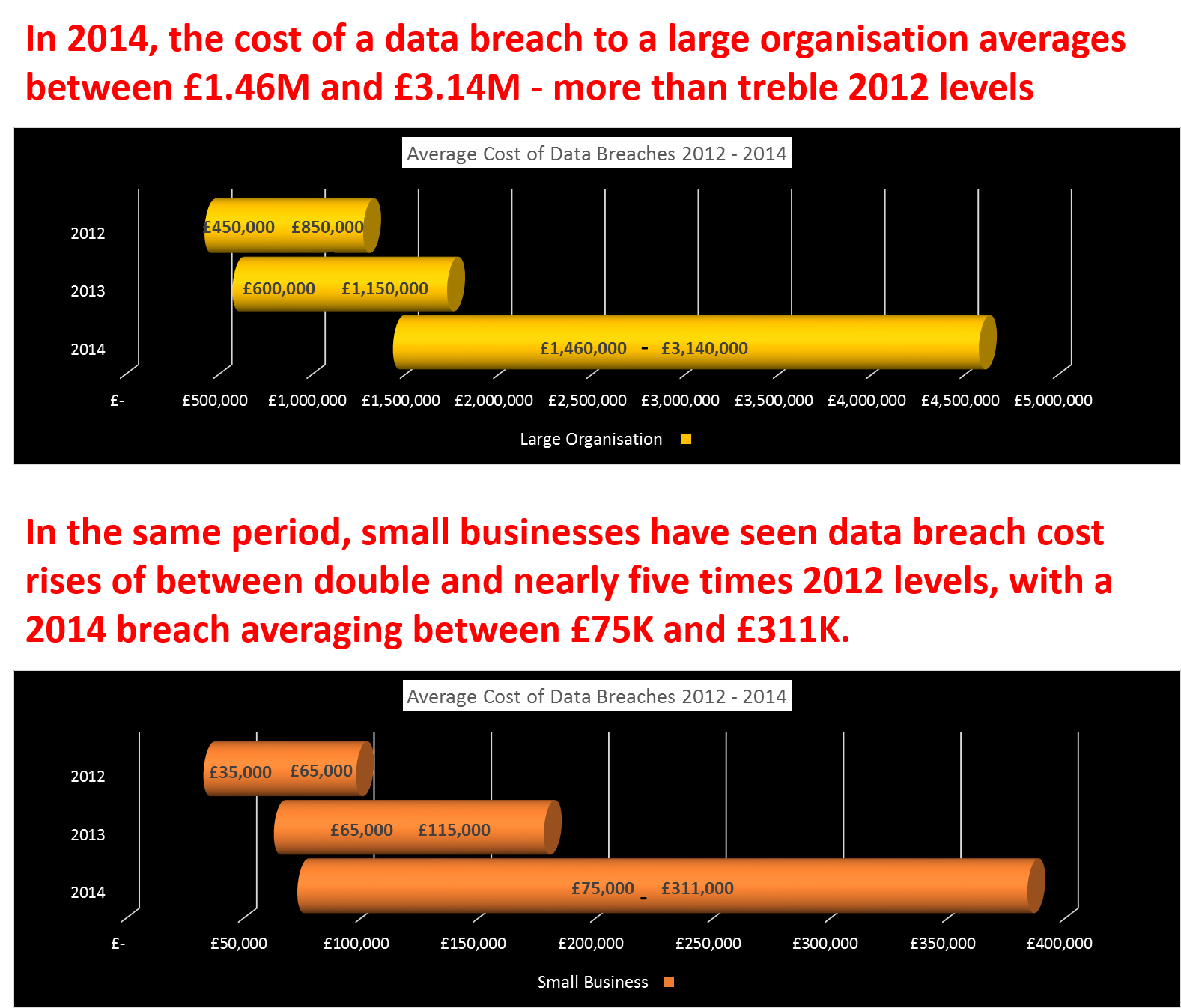
Alarming data breach statistics are shown in the latest survey from HM Government*, with costs increasing to prohibitive levels for businesses large and small.

Data Breach Costs

Data breach 2015 cost graphs and text

Think  a data breach can’t happen to you?  Think again …

data breach percentages graph 2012 to 2014

* All stats taken from 2015 Information Security Breaches Survey commissioned by HM Government – survey conducted by PwC in association with Infosecurity Europe

Protect your data …

Be Aware Be Secure

The protection of your company data must be of paramount importance to you, so please get in touch if you you would like to discuss the ever-changing issues surrounding data security and the steps you can take to keep your data safe.  Call 01787 277742 or email victoria@datacompliant.co.uk

Security and the Internet of Things

I was invited by ComputerScienceZone to share this fascinating infographic on my site – so here it is – a fascinating insight into the diversity and number of “things”, combined with the risks associated with the rapid growth and poor security.

Security-and-the-Internet-of-Things

Data Protection Compliance – who cares?

iStock_000025097331XSmall

More than half the UK population cares enough to bother to start using tick boxes and opt-outs.  And then, of course, there is the Information Commissioner’s Office … they certainly care.  There’s been a general uproar over Google’s methods of data collection … over the NHS hard drives containing sensitive patient information being sold on an internet auction site … over PPI telemarketing calls … and so on … we’re all starting to care more and more over who has, who uses, who owns, who controls and who processes our data – and for what purpose.

What is the Data Protection Act anyway?

That’s why we have The Data Protection Act 1998.  It establishes a framework designed to keep yours and my personal data safe.  And it requires anybody who is a “data controller” – regardless of the size of the business – to register with the Information Commissioner’s Office if they are processing personal information.  There are  a very few exemptions.  To date, over 370,000 organisations are registered.

The Data Protection Act has been designed to balance organisations’ need to collect and use personal data for business and for other purposes versus the rights of individuals to privacy of their personal details.  This balancing act is complex and can be hard to understand.

In addition, the evolving complexities of the internet and e-commerce needed further data protection consideration, so the Privacy and Electronic (EC Directive) Regulations were introduced in 2003. And on top of all that, the EU Directive is still under discussion – this will require further data protection steps to be put into place.

Do I have to comply?

The answer is YES.  Regardless of the size of your business, if you are a data controller and processing personal data, it is a legal requirement to be data compliant.  Part of that process is to notify the ICO that you are a controller and the purpose for which you are collecting and using data.  And it is worth noting that all personal data is covered, including business contacts – business to business contacts are not exempt.

The consequences of non-compliance

handcuffs and money computerIt is progressively unlikely that companies can “get away with” non-compliance.  UK individuals are increasingly aware of their rights in relation to data protection, and are ready to complain to the Information Commissioner’s Office (ICO) if they believe (or just suspect) that a business is not using their personal data compliantly, The ICO can impose fines of up to £ 500,000 against those who are in serious, reckless or deliberate breach of the Data Protection Act.

  • Fines and imprisonment – many breaches are criminal offences, and it’s worth noting that Directors may be personally liable for companies in breach and can be prosecuted and imprisoned.  Having the Information Commissioner turn up on your doorstep with a court order and inspection warrant is highly damaging in terms of reputation, time and resource requirements, and fines.  For example, Tetrus Telecomms was fined £300,000 for serious compliance breaches, and a number of county and borough councils have also been fined for a range of breaches including leaving personal data on a train; losing a laptop containing sensitive personal data and so on.  At the time of writing, the Information Commissioner’s Office has issued 36 fines, totalling £4,236,000 – an average of £117,667 per fine.
  • Publicity – any investigations as a result of complaint are likely to result in very high administration costs, and the Information Commissioner will publicise successful prosecutions or upheld complaints.  In this case, all publicity is absolutely not good publicity.
  • Subject access requests – non-compliance can result both in fine and compensation claims
  • Staff – can be held individually responsible for breaches, and if their employer hasn’t given them the necessary training to comply, they may sue their employer
  • Lost revenue – if the marketing permissions have not been correctly provided when collecting data, then that data may not be used.  In addition, if it is deemed that the data has been collected unfairly, it is quite feasible that the company will be required to eliminate all customer and prospect records from databases.  In either event this can be costly – both in terms of original collection costs and lost revenue

To avoid these issues, the first step towards compliance is to understand the eight clearly defined common-sense principles within the legislation.

The Eight Principles of Data Compliance

The Information Commissioner’s Office summarises the principles of data compliance very clearly:

  1. Personal data shall be processed fairly and lawfully and, in particular, shall not be processed unless(a) at least one of the conditions in Schedule 2 is met, and(b) in the case of sensitive personal data, at least one of the conditions in Schedule 3 is also met.
  2. Personal data shall be obtained only for one or more specified and lawful purposes, and shall not be further processed in any manner incompatible with that purpose or those purposes.
  3. Personal data shall be adequate, relevant and not excessive in relation to the purpose or purposes for which they are processed.
  4. Personal data shall be accurate and, where necessary, kept up to date.
  5. Personal data processed for any purpose or purposes shall not be kept for longer than is necessary for that purpose or those purposes.
  6. Personal data shall be processed in accordance with the rights of data subjects under this Act.
  7. Appropriate technical and organisational measures shall be taken against unauthorised or unlawful processing of personal data and against accidental loss or destruction of, or damage to, personal data.
  8. Personal data shall not be transferred to a country or territory outside the European Economic Area unless that country or territory ensures an adequate level of protection for the rights and freedoms of data subjects in relation to the processing of personal data.

For point 1 above, Schedule 2 examples include:

  • The individual whose personal data is being processed has consented to the processing
  • The processing is necessary in relation to a contract into which the individual has entered or is about to enter
  • The processing is necessary to protect the individual’s “vital interests” – such as medical history for emergency treatment
  • The processing is necessary for administering justice or for exercising statutory, governmental or other public functions)

The term, “sensitive personal data” (in 1(b) above) includes such data as ethnicity, political or religious beliefs, physical or mental health and so on.

How do I comply?

There are a number of considerations in relation to data compliance, including, among the main areas:

  • Notification – the ICO must be notified and accurately advised of the purposes of the personal data you are processing
  • Principles – follow the data protection principles when handling personal information
  • Fairness – the subjects of the data you process must be aware of what you are doing with their personal data
  • Security – this is a vital area, and covers computers, systems and staff.  In summary, it is  vital to

keep personal data secure whether in storage, in use, or legitimately being shared

make sure that data access is restricted only to those who need access to it

be certain than any records or equipment which are destroyed or disposed of do not hold personal information which can subsequently be accessed

    • Policies – data governance is an essential part of data compliance.  Policies and procedures for handling personal data need to be both clear, practical, monitored and enforced.
    • Subject access requests – individuals are perfectly entitled to request a copy of the personal information your organisation holds about them.  You must provide the information requested within 40 days, and may charge a fee of up to £10.  Schools and health authorities operate on a sliding scale up to a maximum of £50.  It is helpful to log and monitor such subject access requests
    • Data processors – when using data processors to process data on your behalf, ensure they are doing so securely and compliantly
    • Training – it is essential that employees and those with access to personal information are fully trained in data compliance.  Employee negligence is a significant factor in terms of data and IT security breaches.  Effective training mitigates the risk of unwitting breaches.
    • Transfer abroad – though sending data to an organisation in the EEA involves the same security and compliance principles as in the UK.  Exporting data to the US requires Safe Harbor or contract to ensure adequate protection for the data subjects.

Keeping your Marketing Compliant

Between them the Data Protection Act 1998 and the Privacy and Electronic (EC Directive) Regulations 2003 are the backbone of compliant marketing use of customer and prospect data – both business-to-business and business-to-consumer, both physical and electronic.

It is increasingly important both to be compliant and to be seen to be compliant in terms of collection and use of personal data, whatever the size of your business.  But it can be a tricky area to navigate.

In our marketing and data consultancy, Tuffill Verner Associates, we have helped businesses navigate data permissions and compliance across B2C and B2B.  With over 30 years experience each, Victoria Tuffill and Michelle Evans are well placed to help marketers stay compliant while still achieving their marketing goals.  We provide clear, tailored practical and creative advice to marketers to solve the difficulties of achieving results while staying within the confines of legal compliance.

If you’d like to chat about your data compliance or governance needs, please call Victoria or Michelle on 01787 277742.