Category Archives: Data Compliance

Data Compliant’s Weekly Round-Up

hacker-1

It’s the weekend before Christmas. Have you done all your Christmas shopping? If you’re shopping online, this is the last weekend you can really do your online shopping and still get everything delivered on time. 

Now you may be bored of hearing it but please be careful, look after your passwords, change them regularly, don’t have devices store your information! Lets start the year without a stranger stealing money from your credit cards and bank accounts!

Yahoo…Again 

This week brings us the news that Yahoo had announced a hack from 2013 – a separate breach to the 500,000 hacked records announced in September. 

Yahoo was investigating the 2014 breach when it uncovered the earlier hack – this time discovering that a billions accounts had been compromised. 

The reputational damage to Yahoo is enormous – a clear pattern of poor security is emerging and if I had an account with Yahoo, I’d be considering changing my provider immediately.  Having said that, though,  how can we be certain that other companies haven’t had similar breaches and we just don’t know about them yet?

The ICO’s deputy commissioner, Simon Entwisle has released a statement saying that they are talking to Yahoo and will try to find out how many UK users have been affected by the latest hack. Their immediate advice is to recommend  strongly that customers change their passwords if they haven’t already.

TalkTalk
An update on the huge TalkTalk hack has been released. One of the hackers, a 17 year old, has admitted to 7 offences relating to the hack and has been given a 12-month rehabilitation order and an £85 fine. He was 
told his excellent computer skills need to be used for the good. 19-year old Daniel Kelley also pleaded guilty. He has been told that a jail sentence is inevitable, and has been released on bail prior to sentencing in March.

Uber
Uber has come under fire after an ex-worker claimed that staff could track fares of celebrities, politicians and even ex-partners. If that’s true, it’s lucky for me I’ve only ever used it in Australia where no exes live and unfortunately I’m not yet a celeb!

Uber released a statement to the Standard stating that the claims made by Mr Spangenberg are “absolutely not true … we have hundreds of security and privacy experts working round the clock  to protect our data … all potential violations are quickly and thoroughly investigated.” Uber also makes it clear that access to personal data is limited to approved workers who may only access the data they need in order to perform their job function. 

Lionhead Studio just as bad as ‘Trolls”?
It has been released this week at a BAFTA event that a teenager targeted Sam van Tilburgh and his team, back in 2003, when they were creating the game Fable. The teen released a screen shot of the hero stabbing a child in the head – something no one was expecting to see. 

Rather than go through official routes, Tilburgh and team decided adopt an unconventional aporiach. They were able to track the boy’s IP address and let care the teenager. They then ‘acquired’ some of his school work from and published a part of it, with a demand that he stop or they would publish more and tell be his family what he was up to. He did indeed stop.

Tilburgh said Lionhead’s legal team knew nothing of the retaliating hack, and it has taken 13 years for the story to surface! I wonder if there’ll be repercussions.

The National Lottery hit with fine
So it wasn’t so long ago we heard that hackers had attacked The National Lottery (TNL). Today we hear TNL’s operator Camelot has been issued with a fine of £3m because of a fraudulent payout back in 2009. How this happened has not yet been announced but  it sounds as if a ‘deliberately damaged ticket’ was to blame. The prize fund payout is suspected to be around £2.5m but the actual figure has not yet been officially released.

I, for one will continue to buy my lottery tickets. Although The National Lottery has come under fire recently, it has fuelled a whopping £36 billion into good causes such as sports, community and heritage projects. Also imagine if you won.. (legitimately)

charlotte-seymour-2016

Written by Charlotte Seymour, 17th December 2016

RSPCA and British Heart Foundation Fined

CHARITY FINED.jpg

So it’s getting closer and closer to Christmas – a time for giving, with more and more charity adverts on the TV, on the radio, on social media – in fact  pretty much everywhere you look. Although Christmas can be a bit tight on the purse strings thousands of people still give to their favourite charities.

Whether you’re helping children, refugees, animals or cancer or medical research, these organisations all promote that the money goes to a good cause. Unless this ‘good cause’ is to pay an ICO fine…?

Two of the major charities we all know and love are the RSPCA and the British Heart Foundation. And both have been under investigation for secretly screening its donors aiming to target those with more money. This process is known as “wealth-screening”.

The two organisations hired wealth management companies who pieced together information on its donors from publicly available sources to build data on their income, property value and even friendship circles. This allowed for a massive pool of donor data to be created and sold.

The RSPCA and BHF were part of a scheme called Reciprocate where they could share and swap data with other charities to find prospective donors. Donors to both charities were given an opt-out option.

Information included in the scheme was people’s names, addresses, date of birth and the value and date of their last donation. The ICO ruled that the charities didn’t provide a clear enough explanation to allow consumers to make an educated decision what it was they were signing up for, and therefore ruled that they had therefore not given their consent.

The RSPCA has admitted that it was not aware of the actual charities with whom they were sharing their data.  It also became clear that the charity shared data of those donors who had opted out.

The BHF insists it had all the correct permissions. However the ICO disagrees on the basis that the charities with whom they were sharing the data were not for similar causes.

The ICO has fined the RSPCA £25,000 and the British Heart Foundation £18,000. Ironically the BJF was praised on its data handling by the ICO in June this year, and it is likely to appeal the fine.

In my opinion I feel the whole thing is a mess. I like to give to charity when I can, which if I’m honest, isn’t as frequent as I’d like.

However when you hear of debacles like this, it really does put you off. I want my money to go to a good cause. I don’t want my data being shared without my knowledge so that other charities can investigate how much I earn, whether I own my property and what social circles I move in, and then decide whether I’m worth targeting. Surely these charities should be thankful for every single donation. The widow’s mite springs to mind.

I feel for the poor animals and souls that rely on these charities, who are I’m sure going to take a hit from these fines. It’s not their fault, yet no doubt it’s them that’s going to pay the price.

charlotte-seymour-2016


Written by Charlotte Seymour, 8th December 2016.

Data Compliant’s Weekly Round Up

cowboy-round-up-cropped

This week has been a bit hectic when it comes to data breaches and news. We started off with Snoopers’ Charter being passed, then we heard that Deliveroo had been hacked and many of its customers had been paying for someone else’s dinner after passwords were stolen from another business.

We heard of yet another colossal hack – mobile network Three had been infiltrated by 3 hackers dotted all over the country now putting two thirds of the 9,000,000 Three customers at risk. The hackers accessed the upgrade system using an employee log in and were able to intercept the new phones before they reached the customers that the hackers had upgraded. Could this be an insider threat? Although Three can confirm no financial data was appropriated the information that was obtainable were things like names, telephone numbers, addresses and date of birth all of which is classed as personal data in accordance with the Data Protection Act. It’s all very handy data for criminals to steal someone’s identity.

Police are investigating Broxtowe Borough Council after an email containing allegations about someone’s conduct was sent to all staff members (730 people in total) in which they were told about in September. The ICO have said they are not going to take any action.

Hatchimals
Hatchimals are the latest craze with the kids these days and I bet they’re on everyone’s Christmas wish list. For those who don’t know what Hatchimals are, they’re Furby-like toys inside an egg that the child has to nurture until it hatches. Once hatched the toy will learn how to speak from it’s owner – so I’m told by my overly eager nephew. However due to these toys being so popular, scammers are out in force and are taking to social media to encourage loving parents to hand over more than double what these toys are going for. Once the scammers have got the money, the parents are then blocked and never hear from them again. Sometimes over £100 worse off. These toys are out of stock in every retailer that sells children’s toys in the UK so if there is an ad online, on social media, or in an email saying they’re still available and better yet – they’re on sale, don’t be fooled, if it’s too good to be true, it usually is.

Black Friday and Cyber Monday
I would imagine due to it being Black Friday this Friday (25th November) and cyber Monday on the 28th fake adverts and phishing emails are going to be on the rise this week and most of next week too. Although it is sad to think that hackers take to this time of year to steal from loving friends and family to earn themselves a bit of extra money, it does unfortunately happen every year. Now some of these hacks are easy to spot, it just takes a bit of common sense, however they are also getting more and more sophisticated and harder to recognise.

Last year UK consumers spent £2 billion in 24 hours online and in stores on Black Friday and £3.3billion over the whole weekend. Predictions this year are even higher than the last. So if you’re anything like me and are planning to get home from work, make yourself a cup of tea, put your feet up and do your Black Friday shopping online, here are some hints and tips for you to stay safe this weekend.

  • Make sure the websites you are visiting have https: at the front of the URL. The s actually stands for secure! Who knew?
  • If you receive any emails from your bank, paypal or anything asking you to confirm your payment details with a link to click on to do so, hover your mouse over the link to see what the URL is, if it isn’t the company’s name .com/.co.uk etc it’s a scam.
  • Look at the email address you receive an email from, is that the company’s name?
  • Use strong passwords, and different passwords for each log in (this is how many people got stung with Deliveroo as they used the same password for their account with them and with other websites and apps).
  • Read the websites privacy policy before handing over all of your sensitive information. These are legally binding and have to inform you of what the company plans to do with your data.

I could go on and on but these main 5 steps should keep you fairly safe this weekend. Don’t be put off by the minority of people who do wish to scam you into handing over all of your money. There are some good people (and even better bargains) out there, so happy shopping!

charlotte-seymour-2016
Written by Charlotte Seymour – 25th November 2016.

Insider Threats – Charlotte’s View

Insider Threats – Charlotte’s View

Something that is being spoken about more and more (due to the unfortunate higher frequency) is insider threat. It’s in the news an awful lot more than it ever used to be.

Do you remember the auditor of Morrisons who released a spreadsheet detailing just shy of 100,000 members of staff’s (very) personal details? He did end up getting jailed for 8 years but I heard a saying recently, it’s not a digital footprint you leave it’s more of a digital tattoo. Even two years after the incident Morrisons is still suffering the effects.

Now obviously that was what you would call a malicious breach. It does unfortunately happen, but there are ways for you to protect your company against this. Firstly we here at Data Compliant believe that if you have detailed joiner processes in place (i.e. thorough screening and references and criminal checks where appropriate), ongoing appraisals with staff and good leaver processes you can minimise your risk.

Other ways of insider breaches occurring, and much more likely in my opinion, are negligence, carelessness and genuine accidents. Did you know that over 50% of data breaches are cause by staff error? This may be because staff do not follow company procedures correctly and open up pathways for hackers. Or it could be that your staff are tricked into handing over information that they shouldn’t.

Your staff could be your company’s weakest point in relation to protecting it’s personal and confidential data. But you can take simple steps to minimise this risk by training your staff in data protection.

Online training has some big advantages for businesses, it’s a quick, efficient and relatively inexpensive way of training large numbers of employees while “taking them out of the business” for the least possible time.

The risk of breaches isn’t just your business’ reputation, or even a hefty fine from the ICO but as mentioned before, also a criminal conviction. Now that is a lot to risk.

If you’re interested in online training have a look at this video.


charlotte

Written by Charlotte Seymour, November 2016


EU – US Privacy Shield has been adopted

Privacy ShieldAt last agreement has been reached on the EU – US Privacy Shield agreement which now replaces the Safe Harbor agreement.  Safe Harbor was ruled invalid in 2015 by the EU Court of Justice, because they said there were not sufficient safeguards for personal data under the voluntary scheme.
The new agreement is intended to protect the privacy of EU citizens when their personal information is processed in the US.

Companies will be able to sign up to the EU – US Privacy Shield from August 1st once they have implemented any necessary changes to comply with the strict compliance obligations.

The EU – US Privacy Shield is based on a system of self-certification by which US organisations commit to a set of privacy principles entitled the EU – US  Privacy Shield Framework Principles.

The new framework was unveiled in February and has been under review since then.  Back in June the European Data Protection Supervisor, Giovanni Buttarelli advised that it ‘needed significant improvements’ because it was not ‘robust enough’ and that the Commission should negotiate improvements to the Privacy Shield in three main areas:

  • limiting exemptions to its provisions;
  • improving its redress and oversight mechanisms,
  • integrating all the main EU data protection principles.

For the Privacy Shield to be an effective improvement on Safe Harbour it must provide adequate protection against indiscriminate surveillance as well as obligations on transparency, and data protection rights for people in the EU.

In Brussels on July 12th Věra Jourová, Commissioner for Justice, Consumers and Gender Equality said: “The EU – US  Privacy Shield is a robust new system to protect the personal data of Europeans and ensure legal certainty for businesses. It brings stronger data protection standards that are better enforced, safeguards on government access, and easier redress for individuals in case of complaints”

In summary the EU-US Privacy Shield is based on the following principles:

  • Strong obligations on Companies handling data and robust enforcement
  • Clear safeguards and transparency obligations on US government access
  • Effective protection of individual rights
  • Annual joint review mechanism
  • Easier and cheaper redress possibilities in case of complaints —directly or with the help of the local Data Protection Authority

The Privacy Shield agreement applies to both data controllers and processors (agents), and specifies that processors must be contractually bound to act only on instructions from the EU controller and assist the latter in responding to individuals exercising their rights under the Principles.

Whilst the UK remains a member of the EU (which it will be for least the next 2 years) UK based companies that process data in the US will be able to use the Privacy Shield where appropriate.

Michelle Evans, Data Compliance Director

14th July 2016

What does Brexit Mean for GDPR?

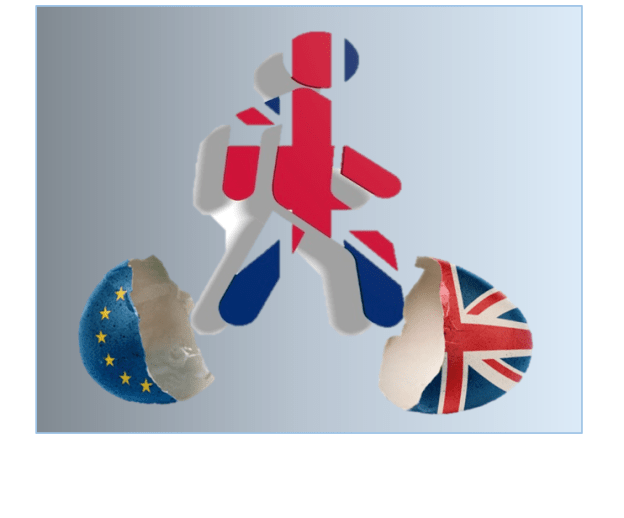
brexit eggBritain has voted to leave the EU, and at this stage it seems that Parliament is going to honour the results and take us out of the EU. So what does this mean for data protection?

I don’t think there has ever been such uncertainty, confusion, difficulty and high risk over data compliance.  So I thought this might help clarify what Brexit is likely to mean in relation to the UK’s data protection legislation.

  1. If Article 50 is invoked in or after October 2016 (as suggested by David Cameron this morning) it will take at least two years and four months for the UK to leave the EU. And, given the complexities of the exit negotiations involved, it may well take longer than that.
  2. EU law will continue to apply until the moment the UK actually leaves the EU, which means that, for a minimum of 5 months, UK organisations – even those which do not process data in Europe – will be required to comply with GDPR. 
  3. If Britain leaves the EU and remains a part of the EEA (like countries such as Switzerland, Norway, Iceland and Lichtenstein), it will be required to comply with GDPR.     
  4. If Britain does not want to be part of the EEA, once it has left the EU it will NOT be required to comply with GDPR.
  5. However, if the UK wants to trade equally with the EU (to quote the Information Commissioner’s Office)UK data protection standards would have to be equivalent to the EU’s General Data Protection Regulation framework starting in 2018.”  To achieve this end, the ICO has already stated its intention to speak to the UK government to explain that reform of the UK law remains necessary Having clear laws with safeguards in place is more important than ever given the growing digital economy”

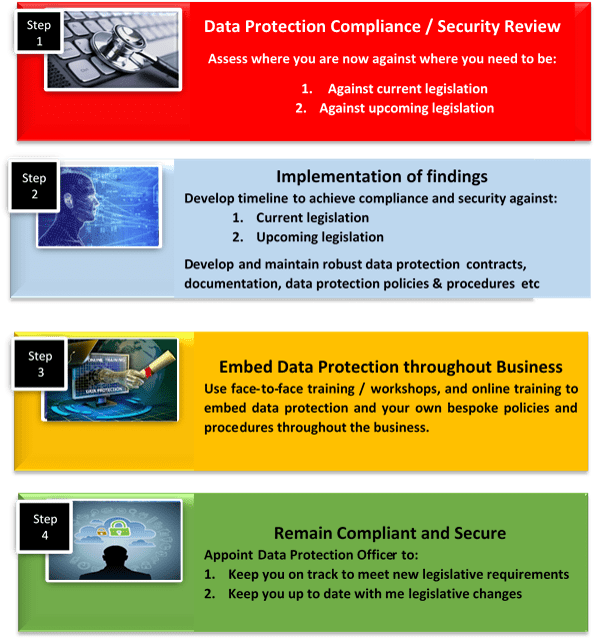
Although it’s too early to know exactly what will happen to UK Data Protection law, what is quite clear is that all UK businesses need to continue making preparations for GDPR compliance.  An excellent starting place is to ensure that you understand and comply with current legislation right now.  I’d suggest the following process:

brexit compliance process

If you have any questions about data protection governance, compliance or security and would like a no-strings chat, please don’t hesitate to call on 0203 815 8003 or email dc@datacompliant.co.uk.

GDPR is here – Data Protection is Changing

shutterstock_128215814The General Data Protection Regulation (GDPR) will become law on 25th May 2018.  This is the biggest data protection shake-up for twenty years and impacts every organisation in the world that processes the personal data of UK and European citizens.

GDPR is designed to strengthen individuals’ rights and give them greater control over their data.  Data breaches and data theft … and the catastrophic publicity that goes with them … are now everyday events.  Just ask Morrisons, Talk Talk, eBay, Altzheimers Society and VTech. Under GDPR, these, and all other organisations will face fines of up to 4% of worldwide turnover or 20 million euros (whichever is higher).

The onus is on Boards, individual directors and management to understand and comply with the Regulation, and to make the critical changes required to the way in which organisations handle personal data.  And the clock is already ticking – there are only 24 months available to make the vital procedural, technical and resource changes required for compliance.

shutterstock_14154718The first issue is to understand exactly what personal data you hold.  This is not always simple. Data’s a bit like a river, and sometimes the flow can just be too fast to control. It may flow down the main stream, pause in a deep pool, join another river at a junction,  then wander off down tributaries, streams and burns, and disappear – only to bubble up unexpectedly in the middle of an isolated moor.  Like a river, data can be full of good and exciting things, or stagnant and disgusting.

 

It is essential to know what personal data you hold, where it is held, where it came from, how it was collected, what evidence you have that it has been collected and processed legally, with whom it has been shared (internally and externally), on what terms it has been bought or licensed, whether and where it has been archived or deleted, and who is responsible for its safekeeping.

Until all that information is in place, there is no chance that you can keep it clean, up-to-date and protect it from external or internal threats.  And there’s absolutely no chance you can comply with the Data Protection Act as it stands now – let alone GDPR.

Data Compliant has developed a quick GDPR Compliance Checker – if you’d like to know more about where you are compared to where you need to be for GDPR compliance, just click here, answer the questions, and we’ll send you a free report, including:

–  your topline level of compliance by category
–  a benchline summary of how you compare with other UK organisations
–  a summary of the key steps you need to take to become compliant
Remember, enforcement begins on May 25th, 2018 – now’s the time to start to get ready.

EU DPA Regulation – 7 Key Changes

EU balance

A good balance between business needs and individual rights

Talks on ensuring a high level of data protection across the EU Marketers are now complete and draft text was agreed on Wednesday 16th December 2015.  Marketers are delighted with the “strong compromise” agreed by Parliament and Council negotiators in their last round of talks.

The draft regulation aims to give individuals control over their private data, while also creating clarity and legal certainty for businesses to spur competition in the digital market.  Back in September Angela Merkel appealed to the European parliament to take a business view rather than simply look at the Regulation from a data protection perspective  lest the legislation hold back economic growth in Europe.  At the same time she described data as the “raw material” of the future and expressed her belief that it is fundamental to the digital single market.

The regulation returns control over citizens’ personal data to citizens. Companies will not be allowed to divulge information that they have received for a particular purpose without the permission of the person concerned.

EU DPA Regulation – 7 Key Changes

  1. 4% Fines:  The Council had called for fines of up to two percent of global turnover, while the Parliament’s version would have increased that to five percent.  In apparent compromise, the figure has been set at four percent, which for global companies could amount to millions.
  2. Data Protection Officers (DPOs):  Companies will have to appoint a data protection officer if they process sensitive data on a large scale or collect information on many consumers.  These do not have to be internal or full-time.
  3. Consent:  to marketers’ relief, consent will now have to be ‘unambiguous’ rather than the originally proposed ‘explicit’ which provides a more business-friendly approach to the legislation. In essence this means that direct mail and telephone marketing can still be conducted on an opt-out basis.  Nonetheless, businesses will be obliged to ensure that consumers will have to give their consent by a clear and affirmative action to the use of their data for a specific purpose.
  4. Definition of Personal Data – the definition has been  expanded in particular by reference to an identification number, location data, online identifier or to one or more factors specific to the physical, physiological, genetic, mental, economic, cultural or social identity of that person.
  5. Online identifiers -whether cookies and ISPs are personal data has been the subject of discussion for some months.  James Milligan of the DMA has expressed the view that a compromise has been reached “Whether or not online identifiers such as cookies fall into the definition of ‘personal data’ will depend on where they are placed in the online ecosystem. For example, a cookie placed by my internet service provider will be classified as personal data as it could identify me, whereas a cookie placed by an advertiser lower down the online ecosystem and cannot be linked to my email address or anything else which could identify me, is unlikely to be considered as personal data.  This represents a sensible compromise as it was feared that all online identifiers would be considered as personal data. This separation means non-identifiable, ‘blind’ data can be more widely used than identifiable personal data.”
  6. Profiling – Profiling has now been included under the term ‘automated decision making’.  Individuals have the right not to be subject to the results of automated decision making, so they can opt out of profiling. It will be necessary to implement tick-boxes or similar mechanisms to secure the data subject’s positive indication of consent to specific processing activities related to Profiling.
  7. Parental consent – Member states could not agree to set a 13-year age limit for parental consent for children to use social media such as Facebook or Instagram. Instead, member states will now be free to set their own limits between 13 and 16 years.


Next Steps

The provisional agreements on the package will be put to a confirmation vote in the Civil Liberties Committee today (Thursday 17 December) at 9.30 in Strasbourg.

If the deal is approved in committee it will then be put to a vote by Parliament as whole in the new year, after which member states will have two years to transpose the provisions of the directive into their national laws. The regulation, which will apply directly in all member states, will also take effect after two years.

Written by Michelle Evans, Compliance Director at Data Compliant Ltd.

If you would like further advice on how the EU Regulation will affect your business, just call Michelle or Victoria on 01787 277742 or email dc@datacompliant.co.uk


Safe Harbor Framework ruled “Inadequate”

global transfers

What was Safe Harbour?

The Safe Harbour Framework was a cross border transfer mechanism which complied with EU data protection laws and allowed the transfer of personal data between the EU and the USA.  More details on how Safe Harbour worked can be found here.

Why was the Safe Harbour Framework invalidated?

After the recent Facebook case ruling, on 6th October, the Court of Justice of the European Union (CJEU) judged that “US Companies do not afford an adequate level of protection of personal data” and therefore the Safe Harbour Framework is now invalid.

The CJEU indicated that US legislation authorises on a general basis, storage of all personal data of all the persons whose data is transferred from the EU to the U.S. without any differentiation, limitation or exception being made in light of the objectives pursued, and without providing an objective criterion for determining limits to the access and use of this data by public authorities.

The CJEU further observed that the Safe Harbour Framework does not provide sufficient legal remedies to allow individuals to access their personal data and to obtain rectification or erasure of such data. This compromises the fundamental right to effective judicial protection, according to the CJEU.  You can read the European Court of Justice Press Release here.

There have been concerns about the Safe Harbour Framework for some time and the European Commission and the US authorities have been negotiating with a view to introducing an arrangement providing greater protection of privacy to replace the existing agreement.

How can I now transfer my data to US?

Organisations that have been using Safe Harbour will now have to review how they transfer personal data to the US and come up with alternative solutions.  However, it is worth noting that the Information Commissioner’s Office has recognised that this process will take some time.  And James Milligan at the DMA states that data already transferred to US-based companies under Safe Harbour will be unaffected.

In the meantime multi-national companies transferring data to their affiliates can look at using Binding Corporate Rules which allow the transfer of data from the EEA to be in compliance with the 8th data protection principle.

Another legal method of transferring personal data to the US is to use the Model Contract Clauses produced by the EU for transfers of personal information outside the EU.

Michelle Evans, Compliance Director at Data Compliant Ltd.

If you are planning to transfer data between the EU and the US, and would like help on how to do so in the light of this new ruling, just call Michelle or Victoria on 01787 277742 or email dc@datacompliant.co.uk

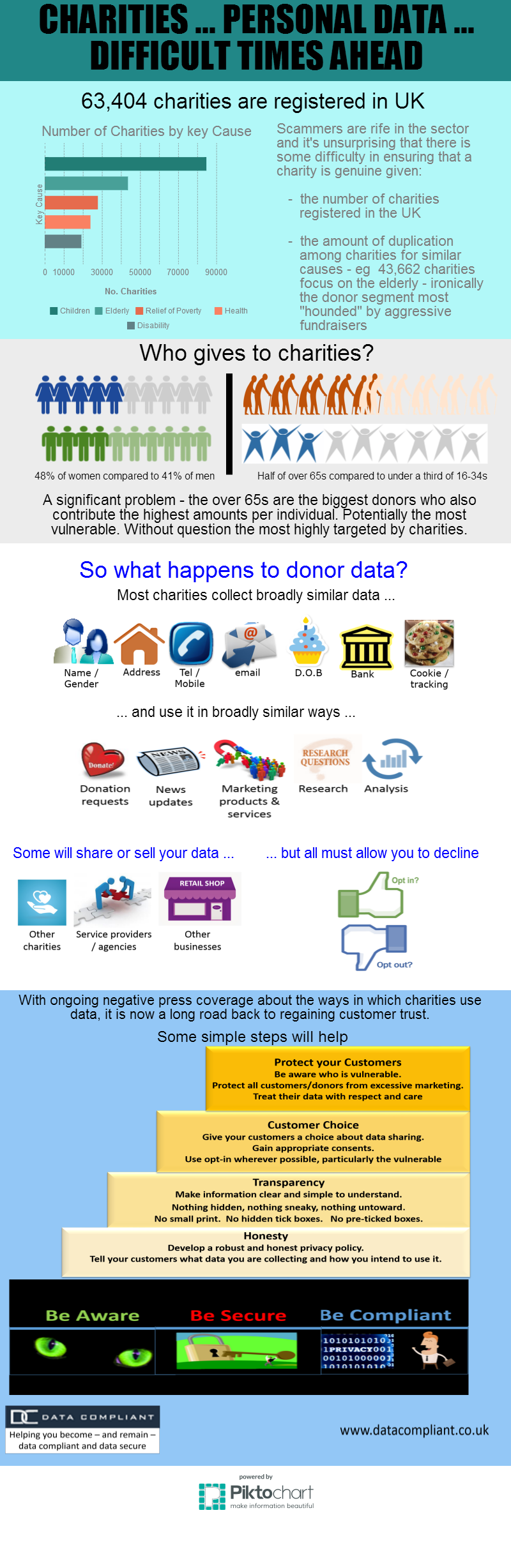
Charities … data protection … reputation

The ongoing stories in the press are hurting charities who are being seen to be treating decent people – particularly vulnerable people – monstrously unfairly.  The press and media are giving consumers an ever clearer perception of the charity sector as being irresponsible, uncaring and aggressive  in their treatment of donors.  And it does the data industry no favours at all.

Charity Data